Claude Revolutionizes AI with Visual Control Capabilities
Anthropic’s latest release of Claude has fundamentally changed the boundaries of AI assistants, granting them visual control capabilities to operate computers and complete various tasks like a human. From WeChat to video editing apps, all closed software is no longer a barrier, and repetitive tasks such as batch processing, cross-platform publishing, and data entry are set to be completely transformed. However, the accompanying security concerns and workplace changes warrant deep reflection—this is not just a technological breakthrough, but a revolution in work methods.
Recently, Anthropic has unveiled a groundbreaking product—not a paper or a demo, but a fully functional tool—marking the entrance of Claude into the “visual control” era.
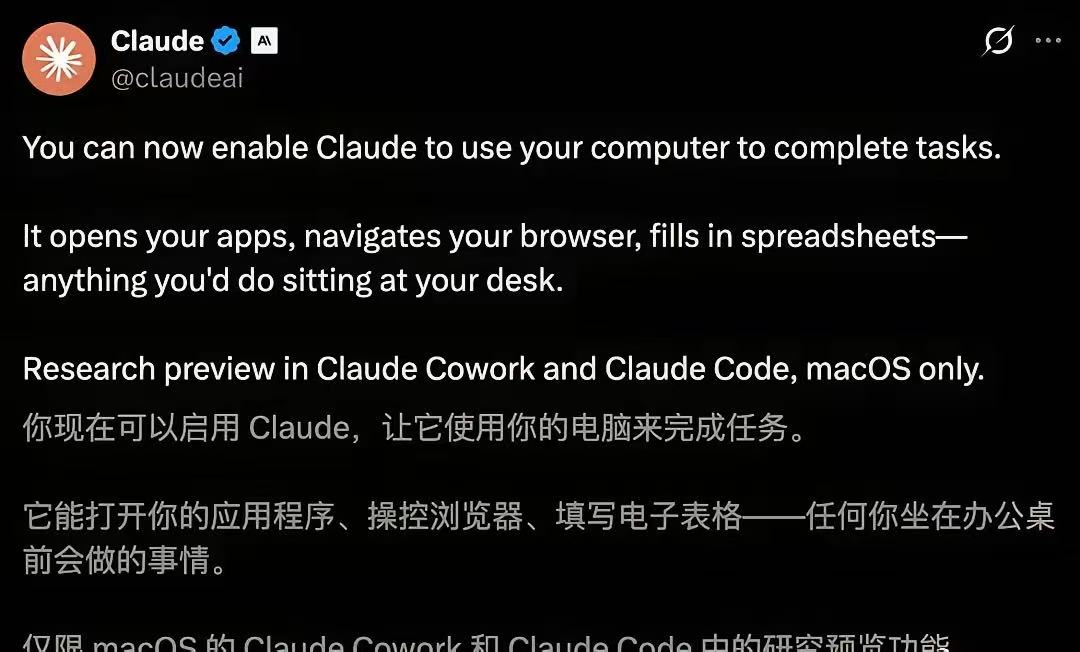
When the news reached the domestic AI community, the initial reaction was disbelief, followed by the realization that this day had finally arrived.
No Longer Just a Chatbot: It Can Actually Work for You
In recent years, AI assistants have become quite powerful, capable of answering questions, writing articles, and analyzing data. However, they have a common limitation: they can only work within the confines of the interfaces provided to them. Once they exceed that range, they become blind and untouchable.
Claude has broken through this ceiling. The new capabilities allow Claude to “see” the computer screen and simulate human operations—clicking the mouse, typing, dragging, opening and closing software. No software interface, API, or cooperation from the other party is required. As long as a human can perform an operation on a computer, AI can do it.
This statement may sound simple, but it fundamentally changes a crucial aspect: the capabilities of AI are no longer limited by how many interfaces software developers are willing to open, but depend on how much humans can do on a computer.
In layman’s terms: previously, when you used AI, you could only utilize the outputs it provided; now, you can have AI operate your computer and complete those time-consuming tasks you do every day.
WeChat, Video Editing, and More—All Closed Software is Vulnerable
To understand the significance of this update, one must grasp a technical background. In recent years, numerous “AI automation” tools have emerged, but they share a common limitation: if software does not open its interface, these tools are rendered ineffective. For instance, if WeChat does not open its interface, automation tools cannot handle it. If a video editing app does not open its interface, no matter how powerful the AI is, it cannot control it.
Claude has broken through this barrier of “closed software.” It does not require software cooperation; it only needs to see the screen. Whatever you can operate, it can operate.
What does a real scenario look like? Imagine you are on the subway and give your phone a command: “Organize the Bilibili videos I follow into a WeChat post.” Claude receives the command, automatically opens the browser on your computer, logs into Bilibili, fetches video information, analyzes content, generates a post, opens WeChat, and sends it to the specified friend—all without human intervention.
Sending personalized files to multiple WeChat friends? AI does that. Automatically editing videos and posting them to Douyin? AI does that. Filling out repetitive forms in internal company systems? AI does that.
Those repetitive operations that consume a significant amount of work time but are essentially worthless are being completely replaced.
With AI’s New “Hands,” Security Issues Escalate
However—there’s always a “but” that deserves serious consideration.
With AI gaining screen visual capabilities and mouse-keyboard control abilities, its permission boundaries have undergone a qualitative change. Previously, if AI made a mistake, the worst-case scenario was that it “said something incorrect.” Now that AI can operate computers, the worst-case scenario becomes “it did a bunch of things I didn’t want it to do.”
Anthropic is aware of this issue and has deployed a dual security mechanism:
- Sandbox Isolation: The AI’s operating environment is isolated from the real system, preventing malicious actions from affecting real data and systems.
- Manual Confirmation Nodes: The first time a new application accesses important operational nodes, user manual confirmation is required. AI cannot arbitrarily open your banking app.
Yet, the real discussion in the tech community is: are these two locks sufficient?
The threat of social engineering is real. AI may not actively do harm, but attackers can craft carefully designed commands that lead AI to “accidentally” execute dangerous operations. The user authorization step itself is a trust node that can be exploited.
A longer-term question is: as AI’s operational permissions grow, who will be responsible for our digital identities, account security, and asset safety?
The key has been given to AI, but the chains are not yet complete.
What Workers Should Care About: Is Your Job Still There?
Returning to what most ordinary people want to know: what does this technology mean for my job?
The conclusion is: it’s not that your specific job will disappear, but the concept of “inefficient execution” is being eradicated from the workplace.
Let’s be more specific. The following types of jobs will be the first to be completely transformed:
- Batch file processing and distribution: Need to modify the same document into different versions and send it to different people daily? AI can do that automatically.
- Cross-platform content organization and publishing: Need to turn Bilibili videos into Xiaohongshu posts, Zhihu answers, or WeChat articles? AI can automatically fetch, generate, and publish.
- Repetitive data entry and reporting: Need to copy Excel data into another system and click a hundred times? AI can do that automatically.
- Scheduled tasks and multi-step workflows: Need to open your computer every morning, log into five systems, check five types of data, and compile a report? AI can trigger and run that automatically.
This is not a prediction; it is happening. When an AI can independently complete the entire loop of “receiving commands → operating software → completing tasks,” how much of your eight-hour workday can this loop cover?
Only you know the answer. But I suggest you think seriously about it.
Conclusion: AI Won’t Make You Unemployed, but Those Who Use AI Will Make Those Who Don’t Unemployed
From a “conversational assistant” to a “digital employee,” Claude has undergone a crucial evolution. It is no longer just a model that can talk. It can think, judge, act, and complete real work in the digital world for you.
What does this mean?
It means that our previous discussions about AI replacement often stated, “AI can answer questions, but ultimately, a human has to execute.” This statement is no longer valid. The last mile between answering and executing has been completely bridged.
Every round of technological revolution will eliminate some old jobs while creating new ones. This time is no exception.
However, one question is sharper than ever: the speed of job transition in this round will be much faster than before.
Those who start learning to “delegate tasks to AI” now will find themselves at the top of the food chain in the next round of workplace reshuffling. Those who continue to work in the old way will find their efficiency gap widening at an observable speed.
AI is not here to take your job. AI is here to redefine what a job looks like.
Your choice determines whether you are the one defining it or the one being redefined.
Comments
Discussion is powered by Giscus (GitHub Discussions). Add
repo,repoID,category, andcategoryIDunder[params.comments.giscus]inhugo.tomlusing the values from the Giscus setup tool.