General Artificial Intelligence (AGI) is Already Here
Recently, while spending a lot of time debugging products, an idea emerged: AGI is not something that will arrive in 3 to 5 years; it is already here, right beside us.
This is a recursive process, so the depth and scope will continuously expand during development, but this does not change the fact that it is present now, not just a future concept.
When AI can fully cover all necessary functions in any role (like programming), it essentially embodies AGI, as every role requires extensive comprehensive judgment.
From Intelligent Native to Unmanned Companies
Recently, the State Council’s opinions on the deep implementation of the “Artificial Intelligence +” initiative prominently mentioned intelligent native enterprises:

Those familiar with the subject may know that I have been writing about intelligent natives since the emergence of large models. At one point, I even considered naming my book “Unmanned Companies” as “Intelligent Native: The Key to the AI Blue Ocean World.”
Intelligent native is not merely a technology; it is a mindset that matches technology with organizational models, transforming the production processes of products and services.
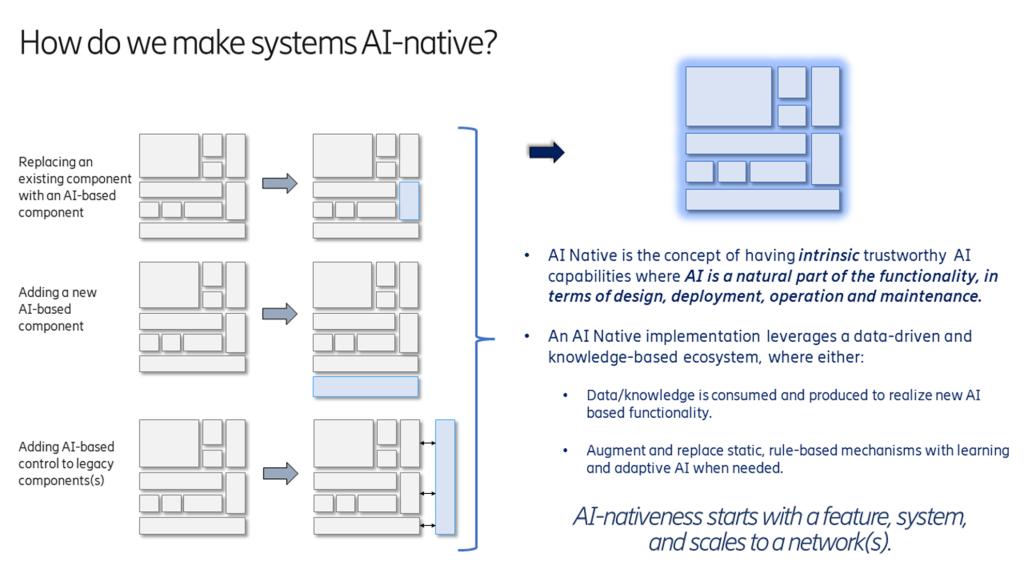
This complexity leads to an awkward reality: mutual understanding is challenging. Those who understand the technology may not grasp organizational operations, and those who understand organizational operations may not comprehend the changes happening in the AI world.
If we believe AGI is around us, this point will undoubtedly become a key obstacle to its implementation. The biggest challenge at this moment is how to construct a system that seamlessly connects human knowledge with partial AGI. Ultimately, this effort aims for the concept of “Unmanned Companies” or AI’s Level 5.
Everything Can Be Rebuilt
A philosophical perspective on change could be: everything is numerical, and ultimate transformation is constant.
Historically, due to the brevity of human life, the significant changes we can perceive are often limited. However, recent history seems to have accelerated, with technologies like the internet and AI emerging rapidly one after another.
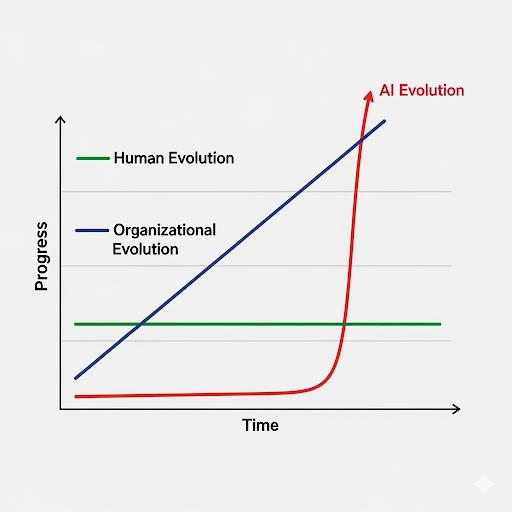
Especially with recent advancements in AI, its evolution speed is astonishing. From an application perspective, today’s AI is fundamentally different from that of 2022.
This speed is the essence of AI’s transformative power: it evolves faster than humans. Human evolution is arduous, making training within companies often ineffective. Processes are relatively quicker, but adjustments are slow due to the involvement of numerous interests, making process reengineering a gradual endeavor.
However, AI rises at an incredible pace, completely reshaping how goals are achieved. This is the core reason why intelligent natives are destined to emerge, and the result is almost certainly that everything can be rebuilt.
Take programming as an example: traditional software development is a highly specialized, collaborative process. A project often requires a product manager for requirement analysis, an architect for system design, front-end engineers for the interface, back-end engineers for logic, and testing engineers for quality assurance. This is a “symphony” completed by different roles and functions.
In the “intelligent native” model, this symphony is being simplified into a “solo.” In this new model, we can continuously input detailed requirements in natural language to coding assistants like Claude Code and instruct them on where corrections are needed.
A friend of mine who works with algorithms recently told me: “This thing is incredibly useful; I completed a delivery without writing a single line of code, accomplishing in one day what a team would have taken several weeks to do.”
Although the forms of production differ, the outcomes of both paths are similar, and the latter is even better. For programming, the latter represents intelligent natives, while the former does not, even if everyone in the former uses AI tools.
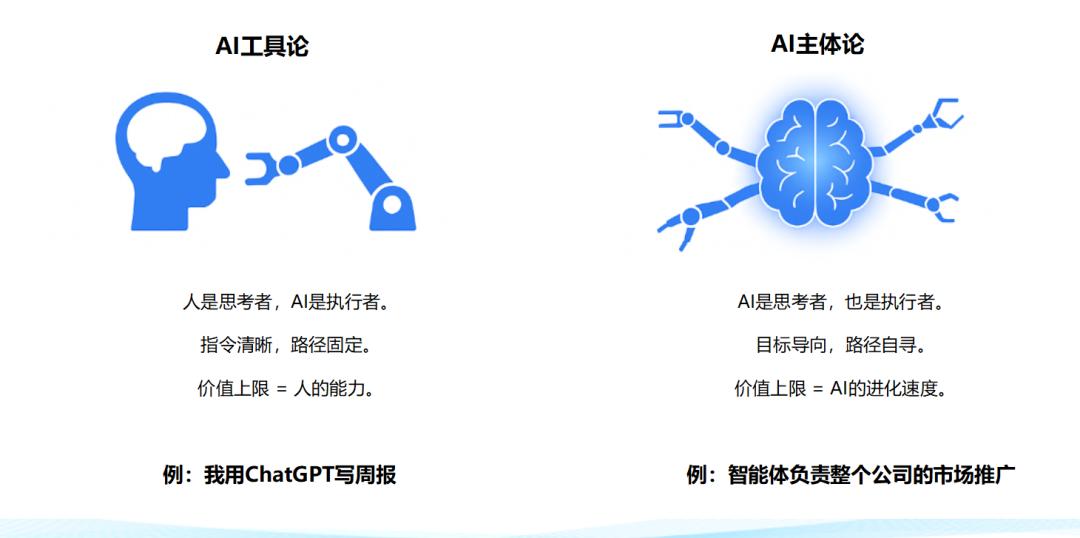
Intelligent natives are a value creation system where AI is the main actor, prioritizing intelligence. AI takes on roles, akin to a kite flying, while humans merely manipulate the string in their hands.
In the intelligent native form, AI becomes the primary entity for value creation, replacing the complex organizational processes of the past with AI-AI collaboration. Organizations are internalized into relationships between intelligent agents.
Recursive Processes and Unmanned Companies
Foldable organizations and businesses improve as intelligence levels rise, making this a recursive process. It can start with a programming team, then recursively extend to operations, where deploying a service on the cloud may no longer require a massive operations team. Eventually, this will encompass many past functions, leading to entire companies.

Interestingly, while I was writing this, a colleague who used to be in operations messaged me, saying:
“Now I can set up k8s/logging elk/monitoring prometheus/mysql/redis/mongodb services in just a week, and not only have I managed PaaS, but I also solved IaaS, all thanks to AI programming. Now I can deploy desired services between self-built IDC and various public clouds, and if I connect the networks in advance, it’s a hybrid cloud.”
This was a goal we worked towards together years ago, and it used to be incredibly laborious, feeling like a year’s worth of effort.
Now, that has changed.
This is also the inherent logic of OpenAI’s five-level model. Agents and organizations are fundamentally the same, differing only in scope and complexity.
The key point here is the previously mentioned evolutionary speed. The pace of AI evolution influences the frequency and depth of recursion, thus affecting the selection of value creation points.
In an ultimate transformation, where value models are rapidly deconstructed and reconstructed, there are no eternal products or values, but the duration of time windows varies.
This is why, after nearly eight years of working with tools, I no longer pursue this field; the sustainability of time windows has significantly shortened.
Your business cycle and commercialization cycle may exceed the technology iteration cycle, leading to a dead end.
The core method to break this cycle is to keep running fast, but the funding environment makes the possibility of running fast nearly nonexistent.
What Needs to Be Mastered is Not Technology, but Value Creation Paradigms
In a rapidly folding context, what truly needs to be mastered is not a specific technology; AI has made the cost of using technology extremely low.
What needs to be mastered is the value creation model—what kind of model can maximize the power of AI?
Although when ChatGPT first emerged, it seemed like a tool, after GPT-4, the constraints of this tool have essentially been lifted.
This is unprecedented in history. One day, a colleague shared a screenshot in the group:
Upon seeing it, I realized it perfectly illustrated the reversal: as AI develops, execution becomes less valuable!
At this point, the paradigm undergoes a fundamental shift; the key is no longer how to use AI technology, but how to encapsulate business with AI.
The key to encapsulating business lies in identifying the real boundaries of AI (often constituted by data and tools).
Then, placing them in a transformative model requires continuously breaking down barriers to AI applications, paving the way for its power to be unleashed.
From a small to large perspective, the smallest is the various tools we see now. Starting from various fragmented tools, one must not stop; stopping means death, as behind lies the overwhelming force of large models folding rapidly.
From a large to small perspective, it is the unmanned company, directly handling final business in an intelligent native manner, focusing on sales and cash flow. Starting is more challenging, as it must address all the inaccessible parts of AI, such as potential data, knowledge, and tools, requiring a system to complete all these aspects.
There are no absolute rights or wrongs, but what needs to be mastered has indeed changed. If one cannot elevate their cognitive perspective, it can be fatal. All efforts may become futile, easily leading to a situation where one digs a well in a desert, only to find no water.
Mastering the New Paradigm Requires AI Thinking
Intelligent priority can be refined into a series of more specific thinking patterns.
For instance, intelligent priority almost inevitably corresponds to virtual precedence, where virtual precedence involves large-scale trial and error. Ultimately, the reason all this holds true is that computational power can offset all uncertainties.
Intelligent priority will also inevitably redefine the boundaries of roles between AI and humans.
AI assisting humans and humans assisting AI may often appear similar, but they are fundamentally different.
It is almost certain that we will inevitably enter a world of inverted dependence. We live in a physical space, but everything in the virtual world pulls this physical world.
Inverted dependence: thinking in terms of digital and AI paradigms.
This may be the true nature of the world, obscured by various barriers.
After all, in the eyes of philosophers, the real world is diverse, and what is considered true existence comes from a shared space.
Thus, AI thinking is a mindset prioritizing digital and intelligent spaces.
Reflexivity and Heat Death
Since the publication of “Unmanned Companies,” I have received much feedback and initiated discussions. The most interesting question is: what would happen if every company were an unmanned company?
In a purely economic world, the basic principle is that the intelligent prevail.
However, if intelligence levels are equal, information gaps and capabilities will also level out. At this point, reflexivity will lead to a world of constant change, with large-scale calculations happening at any moment, but returns may not keep up.
Only costs exist without returns, and the existing system will enter a state of heat death, leading to collapse.
If the spiral ascends, it will enter a new state of civilization. The end of unmanned companies actually hints at this.
This can be seen as another meaning of unmanned companies: technology drives business forms toward existing forms’ endpoints and begins anew.
Conclusion
Verifying that AGI is around us is not difficult; it only requires deep application of models. The challenge lies in changing the world, as without change, AI’s capabilities cannot be realized, leading to a situation of compromising.
What follows is: do you have the power to redefine roles and processes within a certain scope? Only this, combined with AI thinking, can allow AI to produce effects.
Note: You may consider all images to be AI-generated; otherwise, it would be hard to explain.
Comments
Discussion is powered by Giscus (GitHub Discussions). Add
repo,repoID,category, andcategoryIDunder[params.comments.giscus]inhugo.tomlusing the values from the Giscus setup tool.